


Ten years of Cooperation: SMIIC and the Spiritual Administration of Muslims of Tatarstan Solidify Partnership with a New Agreement
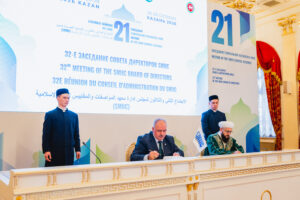
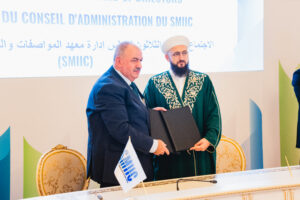
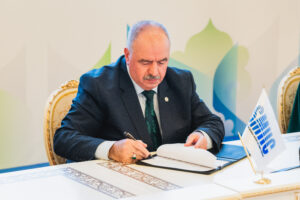
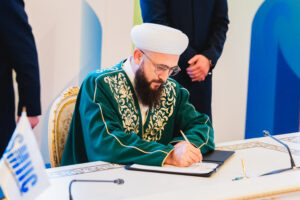
On October 27, 2026, the Spiritual Administration of Muslims of the Republic of Tatarstan and the Standards and Metrology Institute for Islamic Countries (SMIIC)—which operates under the aegis of the Organisation of Islamic Cooperation—signed a cooperation agreement. The document was signed by the Mufti of Tatarstan, Kamil Hazrat Samigullin, and the Secretary General of SMIIC, İhsan Övüt. The ceremony took place at the Kazan City Hall as part of the 21st General Assembly of SMIIC.
For Tatarstan, the signing of this agreement with SMIIC marks the continuation of a partnership that began a decade ago. The initial agreement between the Halal Standard Committee of the Spiritual Administration of Muslims of the Republic of Tatarstan and SMIIC—represented by Secretary General İhsan Övüt—was concluded in May 2017. This new document formalizes the further development of collaboration directly between the Institute and the Republic’s Spiritual Administration of Muslims.
The agreement provides for the exchange of information regarding standards, the hosting of training courses and seminars, the exchange of experts, and the implementation of joint initiatives. It also encompasses areas such as standardization, metrology, conformity assessment, the establishment of laboratories, accreditation, and quality-related matters. For businesses, the practical value of these activities lies in addressing specific operational needs: understanding requirements for raw materials and production processes, preparing documentation, and organizing product assessments—both for export purposes and for the domestic market.
Engagement between Russia and SMIIC has also evolved at the state level. In 2019, Russia was granted observer status within the Institute, with the Federal Agency for Technical Regulation and Metrology (Rosstandart) designated to represent its interests. The decision to hold the 21st meeting of the General Assembly in Kazan was reached on November 13, 2025, during the preceding meeting in Tashkent. According to Rosstandart (the Federal Agency for Technical Regulation and Metrology), the initiative to host the assembly in Russia came from the agency itself. This marked the first time Kazan served as the host city for the event.
A significant aspect of this cooperation has been granting Russian specialists access to SMIIC documents. The Russian Institute for Standardization has identified SMIIC as one of the organizations with which it has concluded agreements for the dissemination of regulatory documentation. Furthermore, Rosstandart announced the inclusion of official Russian-language versions of core SMIIC standards into the Federal Information Fund for Standards. Consequently, these international requirements now have an official channel for distribution within Russia.
One concrete outcome was the registration, in December 2022, of an official Russian translation of the standard OIC/SMIIC 2:2019, “Conformity Assessment – Requirements for Bodies Providing Halal Certification.” This was formalized in an order issued by the Ministry of Economic Development of the Russian Federation on May 14, 2025 (Order No. 309). The availability of an official translation has enabled specialists to work with a unified, Russian-language text of these requirements.
In the Republic of Tatarstan, this cooperation has extended to the training of specialists. From October 26 to 28, 2026, the Halal Standardization Committee of the Spiritual Administration of Muslims of the Republic of Tatarstan, in collaboration with the Russian Islamic Institute, conducted a course titled “Sharia Norms in Production: National and International Halal Standards.” The program integrated Russian standards, OIC/SMIIC requirements, and the Malaysian standard MS 1500:2019; it was designed for enterprise managers and technologists, quality assurance specialists, and staff from certification bodies. On the first day of the event, the training sessions on SMIIC standards were conducted in person by the institute’s Secretary General, İhsan Övüt. Sixty participants are taking part in the training. The involvement of the head of the secretariat of the organization that develops these standards has given the course particular practical significance, as specialists have had the opportunity to study international requirements directly with a representative of SMIIC. The training focuses on the application of these standards within business operations—covering everything from the selection of suppliers and the verification of ingredients to the organization of storage and preparation for certification.
In 2024, the Committee of the Spiritual Administration of Muslims of the Republic of Tatarstan (DUM RT) was granted the status of a Halal certification body in accordance with the “SMIIC-1:2019” standards.
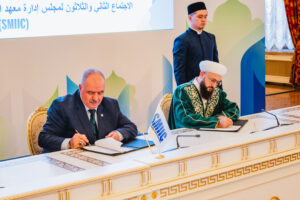

Press Service of the Halal Standard Committee of the Spiritual Administration of Muslims of the Republic of Tatarstan (DUM RT)
Поделитесь в социальных сетях


